
What makes a person successful? Is it drive? Discipline? Patience? Money? Several things can contribute to success. However, certain things can actually hinder success.
This article explores 7 of the most common barriers to success that often stand in our way. I’ll also provide three simple and actionable steps to help you break through each barrier.
Let’s go…
1. Procrastination/Activation Energy
Procrastination is the first of our seven barriers to success. When you delay or postpone tasks because you lack motivation or feel that starting them requires too much effort, sometimes it’s okay to delay tasks as a part of good time management. However, intentionally avoiding tasks that you know you need to do and that may have negative consequences is procrastination. Procrastination is linked to negative emotions and can be more common in people who struggle with their emotions and self-esteem.

The amygdala, a small part of the brain that regulates emotions, motivation, and memory, plays a role in procrastination. When you face a perceived threat, procrastination can be your body’s way of trying to protect itself. This is part of the fight, flight, or freeze response. The amygdala tries to deal with the perceived threat by avoiding it altogether and opting for something less stressful. Procrastination does not necessarily mean that you’re lazy. It can be a result of caring too much or even a fear of failure. We’ll look at this more in part 4.
3 actionable steps to break through this barrier:
- Reduce nearby distractions (making the activation energy required higher for things you don’t want to do and lower for those you do)
- Journal to find out the reason why you’re putting off the task
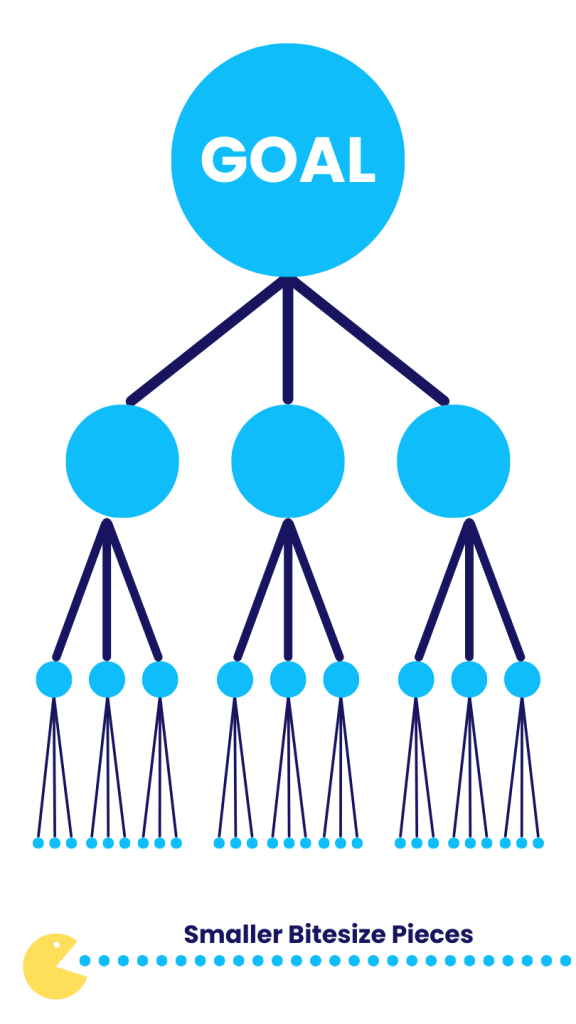
- Break tasks into smaller, manageable steps – breaking tasks into 3 is usually a good idea. If those 3 tasks are still too big, break each of them into 3 again. Keep doing this until you have manageable and actionable tasks.
2. Imposter Syndrome
Around 70% of people experience the second of our seven barriers to success at some point in their lives; imposter syndrome. Imposter syndrome occurs when you doubt your abilities and worry about being revealed as a fake, even though you are competent. This can hurt your confidence, stop you from growing, and make you feel unsure of yourself.
Imposter syndrome can take different forms, such as believing that you don’t deserve success and attributing your accomplishments to external factors like luck. Often, perfectionism and procrastination are used subconsciously as coping mechanisms. This may mean leaving tasks to the last minute to prove that you could have done better if you had put more effort into it or overworking yourself to attribute success solely to hard work.

At the root of imposter syndrome is the fear of being exposed as a fraud, which is closely linked to low self-confidence. Another common feeling is the need to be the best, which can lead to comparing oneself to others who may have had different advantages or have been on their journey for a longer.
3 actionable steps to break through this barrier:
- Acknowledge your achievements
- Seek positive affirmations
- Embrace continuous learning
3. Goal Setting
Although goal setting is generally a very useful tool, there are occasions where it can be a hindrance. When setting goals, it’s important to be realistic and avoid aiming too high. Overly ambitious goals can lead to frustration and loss of motivation. As we spoke about in barrier 1, if a goal is too far out of reach, break it down into 3 and then break those 3 into 3 and so on until the tasks are manageable. Being too rigid and inflexible with goals can make it difficult to adapt to change. Remember, as the Greek philosopher Heraclitus said, the only constant in life is change.

When setting goals, it’s important to be clear and specific. Vague or unrealistic goals can leave you feeling unmotivated and directionless, which can hinder your progress and overall success. To effectively set goals, you need to have clear objectives and actionable plans. Keep sentences short and to the point, and organize your thoughts logically. Use everyday language and avoid acronyms, jargon, and legal language. Stick to the active voice, where the subject does the action of the verb. By following these guidelines, you can ensure your goals are achievable and help you reach your full potential.
3 actionable steps to break through this barrier:
- Make goals specific and measurable
- Break long-term goals into short-term objectives
- Regularly review and adjust goals
4. Fear of Failure
The fear of failure is the anxiety that arises from the possibility of not achieving a desired outcome and is the fourth of our common barriers to success. This fear may cause hesitation and the avoidance of challenges that may come our way. The fear of failure can be so overwhelming that it may prevent us from taking the necessary risks to achieve our goals which can limit personal and professional growth.

I read a page from the Daily Stoic by Ryan Holiday the other day and he gave his take on a quote from Epictetus.
He said something along the lines of; think back to when you were at school, there were always the kids that would mess about rather than try. This gave them the perfect excuse when it came to results; “ It doesn’t matter. I wasn’t even trying”.
Remember, failure is not a defining characteristic. It’s natural to feel anxious about not achieving what you want but don’t let that fear hold you back. Keep pushing forward and know that success often comes from learning from our mistakes.
3 actionable steps to break through this barrier:
- View failures as learning opportunities (L’s stand for lessons not losses)
- Take Kaizen-like steps – Kaizen is the Japanese philosophy of making small, incremental changes over time and can be applied to both business and personal growth. Kaizen translates to continuous improvement and has been used by Toyota since the 1950s to great effect. They don’t just think in terms of the next quarter or the next 5 years. They think in decades.
- Celebrate small successes along the way to reinforce a positive mindset, boosting confidence, and providing motivation to persist in the face of challenges.
5. Resources
The fifth of our seven barriers to success is resources however, resourcefulness is key to success.
Lack of adequate resources, be it financial or educational, can hinder progress. Limited access to funds or educational opportunities may hinder skill development, restrict access to necessary tools, and create barriers to entry in certain fields.
But remember, everyone begins with a different set of skills, varying levels of education, and diverse financial backing. You can improve these factors over time through your learning endeavours and how you invest your time and money. These ultimately don’t determine your final destination or even your journey for that matter. It’s about making the right decisions along the way and learning from the wrong ones (and there will be wrong ones). As mentioned earlier, try to view failures as opportunities to grow.
3 actionable steps to break through this barrier:
- Make sure to prioritize your tasks and budget your resources effectively.
- Seek mentorship and guidance but from someone who is a few steps ahead of you, not someone who is miles ahead and can therefore no longer relate to you
- Make the most of low-cost educational resources like books or even free resources such as free online downloads, libraries, and YouTube videos.

6. Your Circle
Our relationships have a significant impact on our personal and professional growth. Healthy relationships based on trust, respect, and communication help us overcome challenges and succeed in life. Toxic relationships can cause stress and hinder progress. So it’s up to you to identify negative patterns and take steps to either improve them or let them go. Prioritizing healthy relationships creates a positive and supportive environment that fosters personal growth.
You may have heard that you are the average of the 5 people you spend the most time with. This has been a challenge for me in the past. If people you are around are not encouraging, positive and have your back then you may need to reevaluate who you keep around.

Steven Bartlett once said in one of his talks and I think in his book too, “Were you driven, or were you dragged?” He believes that in most cases, successful people are being dragged by some form of insecurity or need for validation. He goes on to say “Initially, I thought these individuals, including myself, were genuinely driven and intentional. I believed we were just making excellent choices and had a strong work ethic. However, I learned that all of these people possess significant levels of shame, which is one of the most powerful motivators that I have ever seen.” Many individuals are pulled towards success because they feel like they have something to prove to their parents, friends, or themselves. What is your motivation? Are you being driven or dragged?
3 actionable steps to break through this barrier:
- Communicate openly about your goals
- Surround yourself with supportive individuals
- Set boundaries when necessary
7. Self-Sabotage
Self-sabotage is a subconscious behaviour which often arises from our mindset and belief system. It includes behaviours and thought patterns that undermine our success. Self-sabotage can take many forms, such as fear of failure, low self-esteem, lack of confidence, past traumas, unresolved psychological issues, procrastination, self-doubt, perfectionism, avoidance of opportunities, negative self-talk, or harmful habits.
If you tend to speak negatively about yourself or overthink the parts of a task that you believe you could have done better, it may be due to having too high expectations or being a perfectionist. Feeling like you always need to be perfect results in feeling like you never achieve anything because the goal in your mind is unrealistic. When you feel like you’re never achieving anything, it’s unsurprising that your self-esteem takes a hit.
3 actionable steps you can take:
- Challenge negative thoughts
- Reach out for help from your circle
- Embrace a growth mindset – A fixed mindset, believing that abilities are static, can lead to avoidance of challenges. Conversely, a growth mindset embraces challenges and views failures as opportunities for learning and improvement.

I hope you have learned how to overcome some of these common barriers to success and maybe even learned something new about yourself. Remember that overcoming these challenges is a journey, not a destination. By implementing the given strategies, you will better equip yourself to break through these barriers to success and achieve the success you deserve.
 Prajay
Leave a comment